Choosing the best wall cladding composite in 2026 requires more than comparing colors, prices, or online ratings. Global buyers need materials that perform in real buildings, changing climates, and demanding supply chains. A panel that looks excellent in a showroom may fade beside strong coastal sunlight or swell after poor installation.
This guide examines wall cladding composite options through practical performance criteria. These include weather resistance, impact strength, fire testing, moisture control, thermal movement, and maintenance needs. It also considers core composition, surface finishes, fastening systems, and available panel sizes. Small details matter. A narrow expansion gap can become a visible buckle during summer heat. A weak coating may lose its finish after repeated cleaning.
Reliable decisions should use verified technical data, independent test reports, installation manuals, and clear warranty terms. Buyers should request physical samples and inspect the edges, coating consistency, and protective packaging. Supplier experience also matters, especially when shipping across different climates and customs environments. Certifications can support confidence, but they do not replace project-specific evaluation.
There is no universal winner. That is worth remembering. A high-density panel may suit busy commercial façades, while a lighter system may reduce structural demands. Some claims also deserve closer review, because laboratory results may not reflect years of exposure. This 2026 comparison aims to help architects, contractors, distributors, and property owners make more informed choices. The final selection should match local regulations, building design, installation skill, budget, and long-term maintenance expectations.
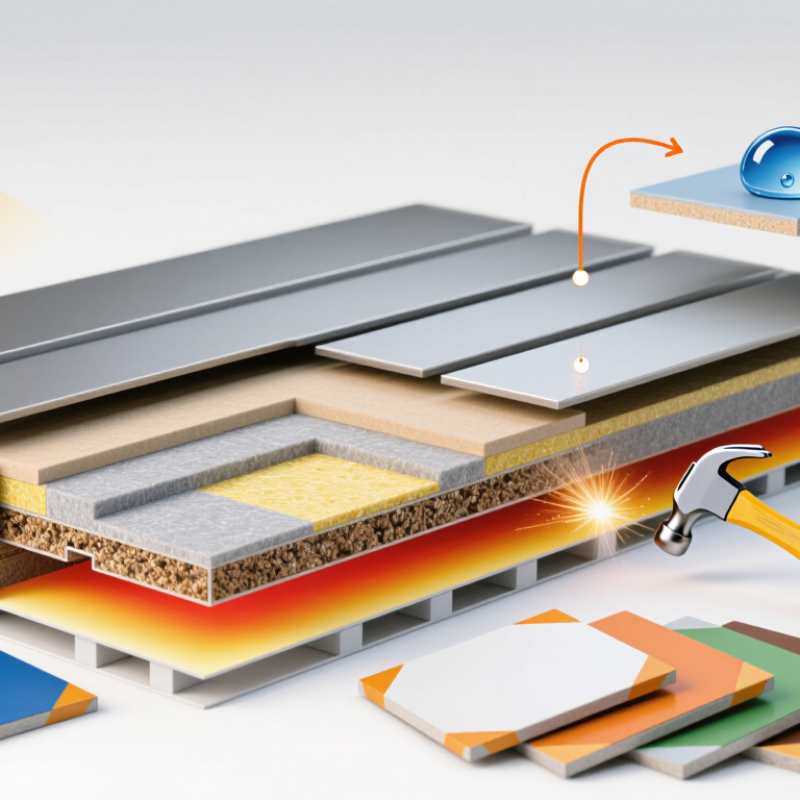
Wall cladding composite combines reinforcing fibers with a polymer, mineral, or resin-based matrix. It may include a protective surface layer for color, moisture resistance, and easier cleaning. In practical projects, panels can arrive with consistent dimensions, while timber often changes with humidity. That difference matters around window corners, roof edges, and ventilated façades.
The 2024 UNEP Global Status Report for Buildings and Construction states that buildings consumed about 32% of global energy and produced 34% of energy-related carbon emissions in 2022. Wall cladding composite cannot solve this problem alone. However, durable panels can reduce repainting, replacement waste, and maintenance access. The International Energy Agency also identifies building envelopes as important to operational energy performance. A well-designed rainscreen may help control heat, air, and water movement.
Global buyers should request fire classification, water absorption, UV aging, impact resistance, and verified environmental data. Standards such as EN 13501-1 and ASTM E84 support comparison, but local codes still control acceptance. The product’s recycled content deserves scrutiny. A high percentage sounds impressive, yet poor recyclability or short service life can weaken the claim. It is not a perfect material. I would not specify it by appearance alone. Substrate movement, fixing design, coastal salt, and installer experience can decide whether a façade performs for decades. Industry forecasts from Grand View Research indicate continued growth in composite materials, but market growth does not guarantee project suitability. The details still matter.
Wall cladding composites are classified by their matrix, reinforcement, core, and surface layer. The matrix binds the material together. Common matrices include polymer, cement, and resin systems. Reinforcements may use wood fiber, mineral fiber, glass fiber, or recycled particles.
Wood-polymer composites usually combine plastic resin with wood fiber. They offer a warm appearance and moderate moisture resistance. Fiber-cement composites use cement, cellulose, and mineral fillers. They provide better fire resistance and dimensional stability in many climates. Aluminum composite panels typically contain metal skins around a polymer or mineral core. Their weight is low, but core composition requires careful specification.
Classification also depends on surface treatment. Options include embossed textures, wood-grain films, factory coatings, and bare panels for later finishing. These layers affect color retention, cleaning needs, and scratch resistance. A realistic assessment should examine the whole wall system, not only the panel.
In project reviews, buyers often focus on density and price. That can be misleading. Fixing clips, ventilation gaps, joint design, and local weather exposure also influence performance. A dense panel is not automatically the best choice. Coastal air, strong sunlight, freeze-thaw cycles, and fire codes may change the recommendation. I would request test reports, installation details, and sample panels before approval. Small samples rarely show long-term color change. That limitation deserves attention.
2026 Best Wall Cladding Composite for Global Buyers?
Global buyers should compare performance, not only color, price, or surface texture. Start with climate exposure. Coastal projects face salt spray, while cold regions demand strong freeze-thaw resistance. High-UV locations need verified color stability, not vague claims. Ask for test methods, exposure periods, and acceptable change limits.
Water management deserves close attention. Review absorption, drainage design, joint details, and resistance to mold growth. Check thermal expansion across the project’s temperature range. A panel may perform well in a laboratory but move noticeably on a long, dark facade. Weight also affects transport, lifting, substructure design, and installation labor. Small differences matter.
Fire classification must match local building regulations and the complete wall assembly. Do not judge a panel alone when insulation, membranes, and cavities change the risk profile. Compare impact resistance, screw retention, repair options, and expected service life. Independent reports and documented projects provide stronger evidence than sales language. Look for installations in similar climates.
No composite is perfect. Some surfaces may fade slightly, scratch, or require careful cutting. That is acceptable only when maintenance needs are clearly stated. A practical review should include warranty limits, batch consistency, replacement availability, and installer training. I would question any product promising universal performance without regional testing. Real decisions often improve after one detail is challenged.
2026 Best Wall Cladding Composite for Global Buyers?
How to Evaluate Compliance, Sustainability, and Lifecycle Value
Choosing composite wall cladding requires more than comparing color, price, and surface texture. Global buyers should request current test reports, technical data, and installation guidance. These documents should match the intended market and building type. Check fire performance, wind resistance, moisture behavior, thermal movement, and indoor air emissions. Requirements vary between countries, and one certificate rarely proves universal compliance. Ask an independent laboratory to confirm unclear claims.
Sustainability needs measurable evidence. Review recycled content, responsible raw materials, manufacturing energy, and an Environmental Product Declaration when available. A durable panel may reduce replacement waste, but only when installed correctly. Examine fasteners, drainage gaps, coating stability, and repair options. I have seen attractive systems fail early because water was trapped behind the panels. That detail matters. No material is perfect. Some composites contain mixed components that complicate recycling, so end-of-life planning should begin before purchase.
Tips: Compare service-life estimates using the same climate and maintenance assumptions. Request sample panels and inspect cut edges, joints, and color consistency. Calculate installation labor, cleaning, repairs, replacement access, and disposal costs. Keep every compliance document in the project file. A cheaper panel can become expensive after one premature repair. A higher-priced system may also disappoint if local installers lack practical training. Test the whole assembly, not only the panel.
This 100-point evaluation framework prioritizes verifiable compliance, measurable sustainability, and long-term lifecycle value. Buyers should validate results with product declarations, fire-test reports, environmental data, warranty terms, and local building-code documentation.
2026 Best Wall Cladding Composite for Global Buyers?
Selecting composite wall cladding starts with the building, not the catalogue. Grand View Research’s 2024 analysis estimates the global wood-plastic composites market will grow at about 11% annually through 2030. That growth brings more suppliers, but also uneven quality. Ask for verified density, water absorption, UV resistance, fire classification, and thermal expansion data. A dense board may feel stronger, yet excessive weight can increase subframe costs. I would not choose from photographs alone.
Source sample panels from the exact production batch. Compare colour, surface texture, edge machining, and hidden fixing details under daylight. Request a technical data sheet, installation manual, warranty terms, and an Environmental Product Declaration where available. For fire safety, check the required classification under EN 13501-1 or ASTM E84. Confirm local approval before ordering. Some products perform well in dry climates but move noticeably beside humid coastlines. That detail is easy to overlook.
Tips: Leave the manufacturer’s movement gap. Use corrosion-resistant fasteners. Keep ventilation behind the boards. Check the subframe alignment with a two-metre straightedge. Record batch numbers during installation. Do not mix profiles from different factories without testing. Energy efficiency also deserves attention: the International Energy Agency reports that buildings account for around 30% of global final energy consumption. Cladding alone cannot solve heat loss, but a ventilated rainscreen, continuous insulation, and sealed junctions can improve real performance. Installation drawings are useful; site judgement still matters.
| Cladding Type | Typical Composition | Typical Weight (kg/m²) |
Indicative Material Cost (USD/m²) |
Expected Service Life (Years) |
Fire Performance | Moisture & Rot Resistance | Recommended Applications | Key Installation Requirement |
|---|---|---|---|---|---|---|---|---|
| Solid WPC Cladding | Wood fibers and thermoplastic polymer, usually with mineral additives and pigments | 18–25 | 35–85 | 20–30 | Project-dependent; fire-retardant grades may achieve higher classifications after testing | High resistance to rot and insects; joints must be drained and ventilated | Residential façades, balconies, hospitality, feature walls | Ventilated cavity, corrosion-resistant clips or screws, and expansion gaps |
| Hollow WPC Cladding | Wood-plastic composite with internal chambers to reduce weight | 10–18 | 25–60 | 15–25 | Usually lower than mineral-based systems unless specifically fire-tested | Does not biologically rot; exposed cut ends require suitable protection | Low-rise façades, soffits, screens, and sheltered exterior walls | Avoid crushing chambers; maintain drainage paths and manufacturer-specified spans |
| Mineral-Filled Polymer Composite | Polymer matrix reinforced with calcium carbonate, alumina trihydrate, or other mineral fillers | 8–16 | 45–100 | 25–40 | Can provide improved flame performance; certification must be verified for the exact panel | Very good moisture resistance when edges and joints are correctly detailed | Commercial façades, rainscreen systems, and high-humidity locations | Subframe must be engineered for panel weight, wind load, and fixing pull-out resistance |
| Fiber-Reinforced Polymer Panel | Glass or mineral fibers embedded in a thermoset or thermoplastic resin | 4–12 | 50–140 | 25–40 | Highly dependent on resin formulation, core, thickness, and tested assembly | Excellent resistance to water and corrosion; UV stability depends on coating | Curved façades, lightweight renovations, coastal and industrial environments | Use compatible saw blades, sealed penetrations, and fixing systems designed for thin panels |
| High-Pressure Laminate Composite | Decorative resin-impregnated paper layers compressed over a kraft-paper core | 8–15 | 45–120 | 25–40 | Obtain the tested reaction-to-fire classification for the complete façade build-up | Good surface resistance; open edges and penetrations must be protected | Ventilated rainscreens, educational buildings, offices, and retail façades | Allow panel movement, use ventilated joints, and prevent water entering the core |
| Aluminum Composite Panel | Two aluminum skins bonded to a mineral, fire-retardant, or polymer-based core | 5–8 | 35–110 | 25–40 | Core type is critical; polymer cores may have substantially different fire performance from mineral cores | High corrosion resistance with suitable coating and correct edge detailing | Commercial façades, signage zones, canopies, and lightweight refurbishment | Confirm routing, cassette fabrication, thermal movement, and wind-load calculations |
| Fiber-Cement Composite Board | Cement, cellulose or synthetic fibers, mineral fillers, and water | 12–20 | 25–75 | 30–50 | Generally strong fire performance; verify classification, thickness, and assembly details | Resistant to rot and insects; edges and cut surfaces require correct treatment | Rainscreens, apartments, schools, and buildings requiring non-combustible surfaces | Use suitable dust control, pre-drilling where required, and a ventilated support system |
| Glass-Fiber-Reinforced Concrete Panel | Cementitious matrix reinforced with alkali-resistant glass fibers | 30–60 | 90–220 | 40–60 | Generally non-combustible or highly fire-resistant, subject to the tested system | Very good durability; joints must accommodate movement and water drainage | Large-format façades, institutional projects, and architectural feature walls | Requires engineered anchors, lifting procedures, and a subframe sized for high dead loads |
| Specify before sourcing | Panel thickness, profile, surface finish, color tolerance, fire classification, wind-load zone, impact requirement, and local building-code approval. |
| Request from suppliers | Technical datasheet, test reports, quality-control records, batch samples, installation manual, packing details, warranty terms, and spare-panel policy. |
| Check landed cost | Material price, tooling, cutting, protective film, packaging, inland transport, ocean or air freight, insurance, duties, taxes, wastage, and installation accessories. |
| Install correctly | Use a drained and ventilated cavity, align the subframe, isolate dissimilar metals, maintain manufacturer-specified joints, and allow for thermal or moisture movement. |
| Important data note | Weights, costs, service lives, and fire performance are typical ranges rather than guarantees. Final selection must be based on the exact product, tested façade assembly, exposure conditions, and applicable local regulations. |