What Is a 3D Magnetic Toy and How Does It Work?

A 3d Magnetic Toy turns invisible magnetic forces into a hands-on building system. Small rods, balls, or geometric tiles connect through magnetic attraction, letting children shape towers, bridges, and free-standing forms. The exact mechanism depends on the design: some pieces contain magnets, while others use magnetic connectors. No batteries. Just geometry, polarity, and a little patience.

The market context is useful, but it needs careful reading. Circana’s 2023 U.S. toy-industry report recorded $28.3 billion in toy sales, down 8% from 2022. That figure describes the wider toy market, not magnetic toys alone. Grand View Research tracks educational toys as a separate market category, but its broad figures do not isolate 3D magnetic construction sets. So market growth should not be mistaken for proof that every magnetic toy teaches equally well.

Play researcher Dr. Stuart Brown offers a relevant, though not toy-specific, observation: “The opposite of play is not work; the opposite of play is depression.” It helps explain why open-ended construction can invite experimentation. A child can rotate a connector, feel it snap into place, and notice how a wider base steadies a tall frame. That is a small lesson in structure. It is not a complete physics class.

Understanding how a 3D Magnetic Toy works means looking at both its magnetic connections and its design. The pieces attract, but the builder decides what they become. And sometimes, the structure falls. That is part of the learning, too.
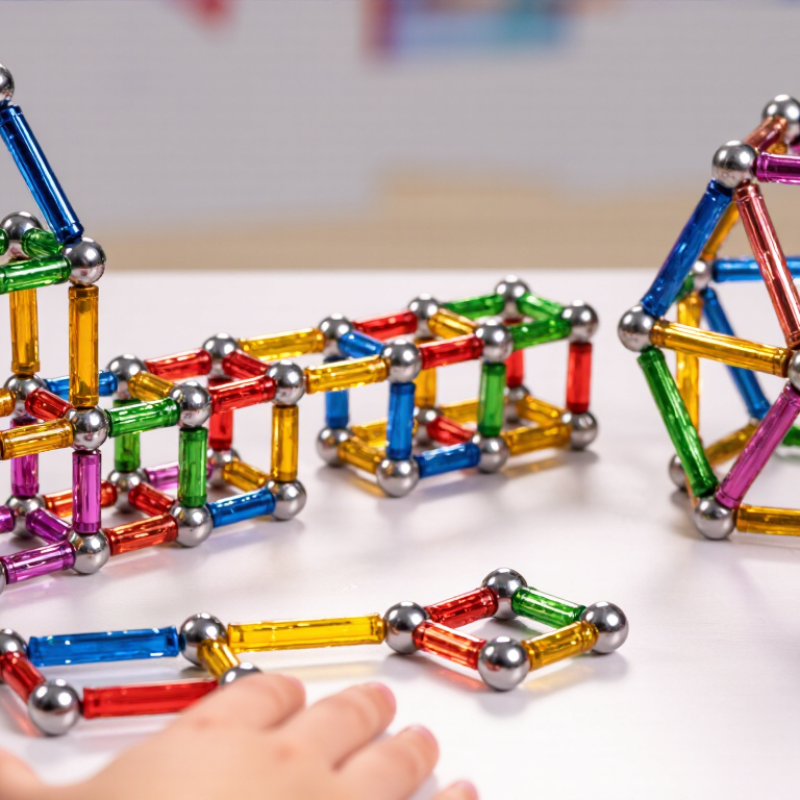
What Is a 3D Magnetic Toy and How Does It Work?

What Is a 3D Magnetic Toy?

A 3D magnetic toy is a construction set whose pieces connect through magnetic force, allowing children to build shapes that stand in space. Unlike flat puzzles, it can form cubes, arches, towers, and irregular structures. Many sets use magnetic tiles, rods, or balls. The magnets may be sealed inside plastic or attached to connectors. Poles matter. Depending on the design, pieces may attract or repel, so children can explore balance and structure through hands-on play. The exact design varies.

Circana’s 2023 U.S. toy industry report estimated toy sales at $40.2 billion, down 8% from 2022. This figure describes the broader toy market, not magnetic toys alone. It does show how varied the toy category is. For a useful set, check the maker’s age guidance, piece size, and connection strength. A small tower that tips when gently nudged can prompt children to rethink its base. Still, play does not always produce a neat lesson.

Tips: Build on a level table and test wide bases before adding height. Keep loose magnetic pieces away from young children, and inspect components for damage. If a connection feels weak, pause and check how the pieces are meant to join.

How Magnetic Force Changes with Distance

A 3D magnetic toy uses magnets to attract, repel, or guide movable parts. This idealized dipole model shows relative magnetic field strength falling approximately with the cube of distance; values are normalized to 100 at one reference distance and are not measurements of a specific toy.

What Materials and Components Make Up a 3D Magnetic Toy?

A 3D magnetic toy typically combines small permanent magnets, shaped connectors, and a protective outer surface. Some designs use neodymium-iron-boron magnets, which create strong attraction in compact parts; others use ferrite magnets. A magnetic core may sit inside a plastic rod or ball, while exposed magnetic pieces may have a metal coating. Small parts matter.

The USGS 2024 Mineral Commodity Summaries reports 350,000 metric tons of rare-earth mine output worldwide in 2023, including 240,000 tons from China. Neodymium is one rare earth used in many high-strength magnets. That figure describes the wider supply chain, not toy production. Toy-specific material shares are not separately reported, so exact percentages would be misleading.

Casings commonly use polymers such as ABS or nylon, chosen to resist everyday knocks and keep components aligned. Some pieces also use steel shells or plated surfaces. Coatings can wear, though, and a smooth finish does not prove a magnet is safely enclosed. ASTM F963-23 includes requirements for toys containing magnets, making enclosure and part integrity important design checks. A close look at seams, cracks, and loose components can reveal problems that a bright color may hide.

How Do Magnetic Forces Connect the Pieces?

A 3D magnetic toy connects through fields that extend beyond each visible piece. Inside a plastic tile, small permanent magnets create north and south poles. Opposite poles attract; matching poles repel. The click is tactile, but the connection is not a latch. It is magnetic force acting across a narrow gap.

Distance matters sharply. In the standard dipole model, magnetic force falls approximately with the fourth power of separation. Double the gap, and the force can drop to about one-sixteenth. Real toy pieces may differ because magnet size, alignment, and nearby materials affect the result. That estimate is useful, but not a promise about any specific set. ASTM F963-23 includes requirements for toys containing magnets, making magnet retention and accessible parts important design considerations. The standard is a safety benchmark, not a measurement of how strongly pieces connect.

Try bringing two edges together slowly. You may feel a slight pull before the pieces touch; rotate one tile, and the pull can become a push. Small shifts matter. Magnets hidden inside can be oriented differently, so a piece may connect on one edge yet resist another. I would not assume every connection is equally strong. Builders can test joints gently, especially in taller structures where a loose connection may tip the shape.

How Can the Pieces Be Arranged Into Three-Dimensional Shapes?

A 3D magnetic toy uses magnetized pieces to connect into shapes that stand upright, rather than lying flat. Depending on the set, pieces may be rods and balls, or flat shapes with magnets along their edges. Connections form when compatible magnetic poles meet. Some joints swivel easily; others hold a fixed angle.

To build a cube from flat tiles, connect four squares into a strip, then fold the strip into side walls. Add a top and bottom, checking that each edge attracts before letting go. With rods and balls, use balls as corners and rods as edges: six square faces need eight corner points and twelve connecting rods. Start on a table. A stable base helps.

Small adjustments matter. If a panel drops, the magnets may not be aligned, or the structure may be too wide for its base. Turn one piece around and test the connection gently; forcing it can make the frame twist. I still find that neat-looking designs can wobble more than expected. That is useful feedback. Try a lower shape, add a cross-rod, or rebuild one section at a time. The toy can teach balance, symmetry, and spatial reasoning, but the pieces do not always behave as the diagram suggests.

What Factors Affect the Toy’s Safety and Durability?

A 3D magnetic toy uses magnets inside separate pieces to help them attract, repel, or hold a shape. The magnetic field is invisible, but its effect is easy to see as pieces click together or shift apart. Designs vary: some use enclosed magnetic balls, while others combine rods and connectors. The magnets should remain securely sealed inside the parts.

Safety depends on the toy’s construction, the child’s age, and how it is used. Small pieces can pose a choking risk, and loose or swallowed magnets can cause severe internal injuries. Check age guidance and supervise young children. Before play, look for cracks, loose seams, sharp edges, or magnets that seem to move inside a piece. Even a sturdy-looking part can hide a hairline crack. Durability also depends on materials and care. Repeated drops, twisting, moisture, and heat can weaken housings or joints. I would not assume a toy is safe just because it still connects normally; damage may be hard to spot.

Tips: Inspect pieces before and after play, and stop using any damaged part. Keep magnets away from very young children and store the set in a closed container. Clean pieces with a soft, slightly damp cloth, then dry them fully. Avoid pulling connectors apart by force.

What Is a 3D Magnetic Toy and How Does It Work? - What Factors Affect the Toy’s Safety and Durability?

Topic or Factor How It Works Safety and Durability Considerations What to Check
What a 3D magnetic toy is It is a construction toy whose pieces use magnets to connect, allowing a user to make flat patterns or three-dimensional forms. Pieces should be suitable for the intended age group and used as directed. Small parts can present a choking hazard for young children. Check the age guidance, warnings, and instructions on the packaging.
Magnetic connections Magnets create a magnetic field. Opposite magnetic poles attract, helping compatible pieces hold together; some designs use freely rotating magnets to let pieces connect in different orientations. The magnets should remain securely enclosed. A loose or swallowed magnet can cause serious internal injury, especially if more than one magnet is swallowed. Look for cracks, gaps, loose pieces, or other signs that a magnet could become exposed. Stop using damaged pieces.
Magnet strength and design Magnet size, material, orientation, and distance affect how strongly pieces attract and how well a structure stays together. Strong magnets require secure containment and clear safety warnings. The toy should be designed and labeled for its intended users. Follow the manufacturer’s guidance, and keep magnetic pieces away from people who may swallow them and from magnet-sensitive devices where advised.
Piece size and shape Different shapes and connection points let users build structures with varying forms and levels of stability. Small components may be unsuitable around children who still put objects in their mouths. Thin sections or narrow connectors may be more prone to breakage. Use age-appropriate pieces and check connectors for bending, splitting, or sharp edges.
Housing and material quality A plastic, metal, or other housing holds the magnet in place and forms the outside of each piece. Durability depends on material quality, wall thickness, and how securely the housing is joined. Damaged coatings or housings can expose internal components. Inspect for cracks, peeling, corrosion, sharp edges, and separation at seams.
Assembly and impact wear Repeated connecting, pulling apart, dropping, or stepping on pieces places stress on housings and joints. Repeated impacts can weaken a piece or loosen its magnet even when damage is not immediately obvious. Examine pieces regularly, especially after drops or rough play. Remove any piece that is damaged or behaves differently.
Cleaning and moisture Cleaning removes dirt and residue from surfaces and connection points. Moisture or harsh cleaning products may damage some materials, finishes, or internal components, depending on the toy’s construction. Follow the cleaning instructions. Dry pieces thoroughly and do not immerse them unless the instructions say this is safe.
Storage and supervision Keeping pieces together in a suitable container makes them easier to inspect and reduces the chance of losing components. Supervision and secure storage can help keep small or damaged magnetic pieces away from young children and pets. Store pieces out of reach when not in use, and count or inspect them after play.

Note: Safety and durability vary by product design and condition. Follow the toy’s instructions and applicable local safety guidance; do not use pieces that are cracked, loose, or otherwise damaged.