Why Are Transport Vehicles Essential for Modern Society?
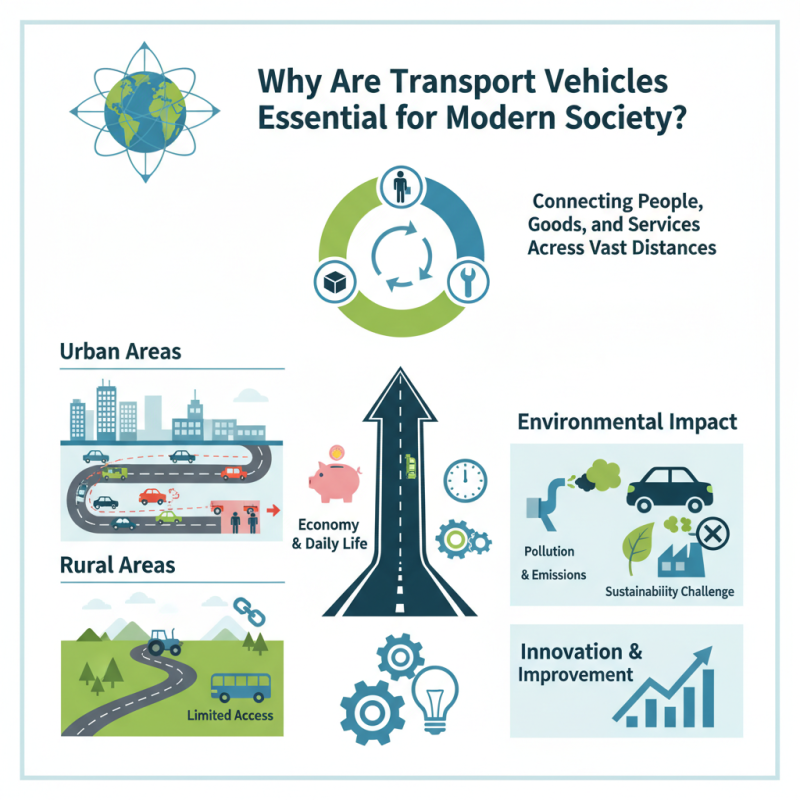
Transport vehicles are vital for the functioning of modern society. They connect people, goods, and services across vast distances. As Dr. Jane Smith, a renowned transportation expert, once said, "Transport vehicles are the lifeline of our economy and daily life." This statement underscores their importance in our world.
In cities, transport vehicles ease traffic congestion. They facilitate commuting and reduce travel times. Yet, many urban areas still struggle with inadequate infrastructure. This can lead to delays and frustrations for users. Rural areas face even greater challenges. Limited access to transport vehicles can hinder economic growth and accessibility.
Furthermore, the environmental impact of transport vehicles cannot be ignored. While they provide essential services, they contribute to pollution and greenhouse gas emissions. Society must balance the need for efficient transport with sustainability. This ongoing challenge prompts reflection on how we can innovate and improve our transport systems efficiently.
Importance of Transport Vehicles in Global Trade and Economy
Transport vehicles play a crucial role in global trade. They are the backbone of the supply chain. Without them, goods cannot move efficiently from one place to another.
Shipping containers travel vast oceans. Trucks navigate through city streets. Trains connect remote areas to bustling markets. Each mode has its challenges. Delays can occur due to weather or mechanical issues. Roads may become congested, hindering timely deliveries. These problems highlight the need for constant improvement.
Economic growth heavily relies on transport vehicles. They enable international commerce, allowing products to reach consumers. However, infrastructure struggles to keep pace. Many regions still lack adequate transport networks. This gap can stifle trade and create inequalities. As society evolves, addressing these issues becomes vital for a flourishing economy.
Importance of Transport Vehicles in Global Trade and Economy
Statistics on Freight Transportation: Volume and Value in Modern Trade
Freight transportation plays a vital role in global trade. In 2022, the value of freight movement reached over $8 trillion in the United States alone. This staggering figure highlights the importance of efficient transport systems. Trucks moved nearly 72% of all freight in the U.S., reflecting their critical role in daily commerce.
However, this growth brings challenges. The demand for shipping is rising, but infrastructure is lagging. A recent report indicated that 20% of U.S. roads are in poor condition. This affects delivery times and increases costs. Moreover, environmental concerns are also on the rise. Transport contributes approximately 29% of greenhouse gas emissions in the U.S.
As we rely heavily on transport vehicles, the industry must innovate and adapt. New technologies are needed to improve efficiency. Electric vehicles and autonomous systems could reshape freight transportation. If the issues of congestion and pollution are not addressed, future growth may be hindered. Transportation is essential, but it must evolve to meet modern demands while being responsible.
Impact of Public Transit Systems on Urban Development and Sustainability
Public transit systems play a crucial role in urban development and sustainability. According to a report from the American Public Transportation Association, every $1 invested in public transit generates about $4 in economic returns. This highlights the importance of investment in transit to drive local economies. However, not all cities prioritize such investments, leading to disparities in public transit accessibility.
Cities equipped with robust transit networks tend to experience more sustainable growth. The existence of efficient transport options reduces dependence on personal vehicles, lowering carbon emissions. In Los Angeles, for example, a significant increase in public transit use led to a reported 20% decrease in traffic congestion. Yet, issues like overcrowding and service reliability need addressing to fully realize transit's potential.
Urban planners must reflect on the current state of public transit. Despite its benefits, many systems remain underfunded. Areas without access suffer from economic stagnation. Data reveals that 45% of low-income workers cannot reach job locations within 30 minutes using public transit. Clearly, there is room for improvement in ensuring equitable access for all residents. Enhanced investment can lead to better service and more inclusive urban environments.
Role of Transport Vehicles in Emergency Services and Disaster Response
Transport vehicles play a crucial role in emergency services and disaster response. These vehicles are often the backbone of any effective response team. When disasters strike, time is of the essence. Ambulances rush to save lives. Fire trucks transport firefighters to combat blazes. These vehicles ensure that help arrives quickly.
In emergency situations, not all transport vehicles are equipped for every scenario. For instance, some may struggle in rough terrains like floods or earthquakes. This raises questions about preparedness. Are responders using the best vehicles for their environment? Sometimes, vehicles lack proper equipment, making a difficult situation even harder.
Moreover, coordination between different units is vital. Transport vehicles need to communicate effectively. However, this isn't always the case. Misunderstandings can slow down rescue efforts. Think about how an improper vehicle choice can hinder a timely response. Each vehicle has its strengths and weaknesses, impacting overall effectiveness. Being aware of these limitations could lead to better strategies in future emergencies.
Advancements in Transport Technology: Enhancing Efficiency and Safety
Advancements in transport technology have redefined efficiency and safety, shifting the landscape of modern transportation. For instance, the adoption of AI in logistics is transforming how goods are delivered. According to a recent study by McKinsey, companies leveraging AI can improve delivery times by up to 30%. This sharp increase in efficiency creates a competitive edge. However, as these technologies advance, they face challenges, such as cybersecurity threats. Transport systems must evolve and address these vulnerabilities to ensure safety.
Another notable advancement is the rise of electric vehicles (EVs). The International Energy Agency reports that EV sales doubled in the last year to reach 10 million globally. This growth highlights a crucial shift towards sustainable transport. However, the infrastructure for charging remains inadequate in many areas. Urban planners must focus on expanding charging networks. The transition to electric transport isn’t flawless and requires systemic adjustments. Balancing innovation with practical solutions is essential for societal impact.
Why Are Transport Vehicles Essential for Modern Society? - Advancements in Transport Technology: Enhancing Efficiency and Safety
| Transport Vehicle Type | Efficiency Improvements | Safety Features | Environmental Impact |
| Electric Bus | Reduced energy consumption by 40% compared to diesel buses | Collision avoidance systems and automatic braking | Zero tailpipe emissions |
| Self-Driving Car | Increased traffic efficiency by reducing congestion | Advanced sensors and real-time monitoring | Lower carbon footprint through optimized driving patterns |
| High-Speed Train | Travel time decreased by 50% on major routes | Automatic signaling and redundant systems | Lower emissions per passenger kilometer |
| Cargo Drone | Cut delivery times by up to 60% | Obstacle detection and automated landing | Potential for lower carbon emissions through electric models |