In 2026, an Intelligent Pole is more than a streetlight with a network connection. It can combine efficient lighting, cameras or sensors, wireless communications, public Wi-Fi, and traffic equipment on one structure. The best design depends on the street, not the product brochure. Details matter.
This guide introduces the main types: smart lighting poles, 5G and small-cell poles, environmental monitoring poles, traffic and public-safety poles, and multifunctional models that combine several systems. Some designs also support electric-vehicle charging, but that feature requires careful planning for power capacity, access, and maintenance. One pole cannot do everything well.
The comparison looks at what each type does, where it fits, and what buyers should check before deployment. For example, a coastal road may need corrosion-resistant materials, while a busy junction may prioritize clear sensor coverage and reliable communications. Performance claims should be checked against local conditions, technical specifications, and independent project evidence. These details can be overlooked.
There is no single “top” pole for every city. Budgets, existing infrastructure, privacy expectations, and long-term servicing all shape the choice. Some projects may also discover that fewer integrated features are easier to maintain. The sections ahead offer a practical way to compare options without treating newer technology as automatically better.
In 2026, smart-lighting poles are valuable not just for the equipment mounted on them, but for the energy their luminaires can save. The U.S. Department of Energy’s municipal street-lighting guidance reports that LED conversions can reduce streetlight energy use by 50% or more compared with conventional lighting. The exact result depends on the old lamps, roadway layout, and chosen light levels. A measured baseline matters.
LEDs direct light onto the road more precisely, reducing wasted spill onto sidewalks and building façades. Add photocells, adaptive dimming, and traffic sensors, and the pole can adjust output as conditions change. DOE’s 2019 Energy Savings Forecast of Solid-State Lighting in General Illumination Applications projected 5.1 quadrillion Btu in annual U.S. energy savings by 2035, compared with a baseline without broad adoption. That forecast covers lighting broadly, not streetlights alone. Keep the distinction clear.
A practical retrofit starts with a nighttime audit: note dark patches, glare, and empty roads after midnight. Then compare actual electricity bills before and after installation. Not automatic. Poor aiming or overly bright settings can erode savings, and sensors need sensible schedules. A pole may be “smart” on paper, yet still waste power if nobody reviews its operating data.
Illustrative energy-use index: conventional streetlighting is set to 100; the LED value of 50 represents a potential reduction of up to 50%. Actual savings vary by installation and operating conditions.
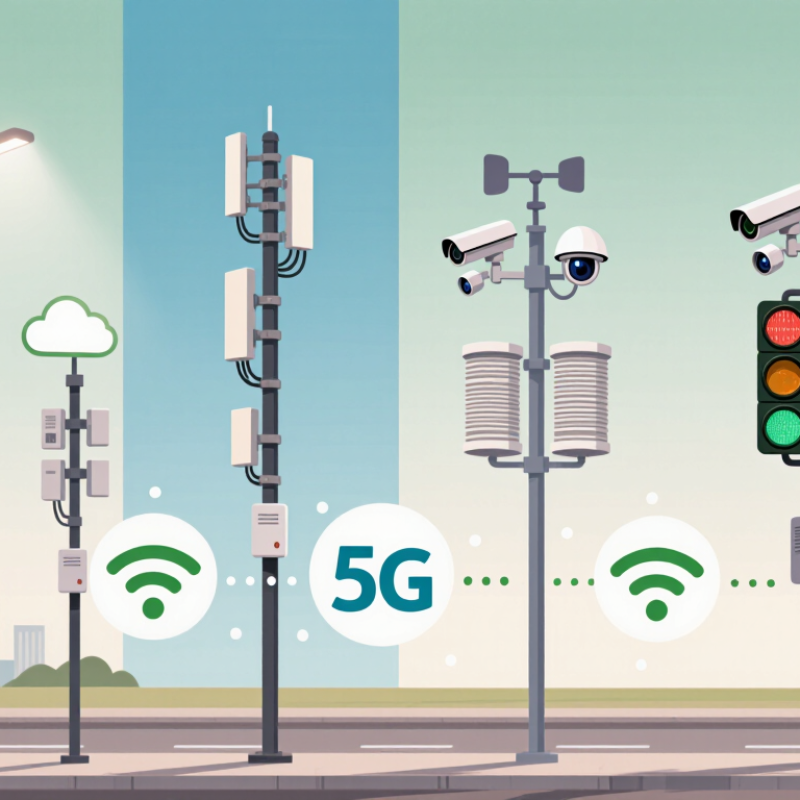
For 5G small-cell poles, the radio band shapes the installation. 3GPP TS 38.104 places NR in FR1, from 410 MHz to 7.125 GHz, and FR2, from 24.25 GHz upward. Sub-6-GHz signals generally cover wider areas and travel through obstacles more effectively. mmWave can deliver high capacity, but its shorter reach often calls for denser pole placement. That distinction matters on streets with trees, buses, and glass façades. A pole may combine antennas, power, backhaul, and environmental sensors, but available space and heat management still limit the design.
The Ericsson Mobility Report, November 2024, estimated 2.3 billion 5G subscriptions by the end of 2024 and forecast 6.3 billion by 2030. That growth points to continued demand for small cells, not a guarantee that every street needs mmWave. Sub-6-GHz poles can support broad coverage, while mmWave installations suit busy, high-demand locations. In practice, site surveys matter more than a neat coverage map. Real streets are messy.
Tips: Check the exact 3GPP band, local obstructions, and backhaul capacity before choosing a radio. Compare peak capacity with usable street-level coverage. A mixed-band design may work better, though it can add cost and maintenance.
Environmental-sensing poles bring air-quality monitoring closer to where people walk, wait, and live. Their sensors can track fine particulate matter, including PM2.5, alongside weather conditions such as temperature and humidity.
The World Health Organization’s 2021 air quality guidelines recommend an annual mean PM2.5 concentration of no more than 5 μg/m³. This is a yearly average, not a daily alert threshold. That distinction matters.
A pole beside a busy road may register short-lived pollution peaks from traffic or nearby activity. Those readings offer useful local clues, but one sensor cannot describe an entire neighborhood. Small sensors can drift, and humidity may affect measurements. Not perfect.
Regular calibration and comparison with reference-grade monitors help make the data more dependable. Clear public displays should explain where measurements were taken, how often they update, and what averaging period they represent.
The WHO guideline gives cities a strong health-based benchmark, but meeting it cannot be judged from a single pole or a single day of readings.
EV-charging poles turn street furniture into practical infrastructure. They can combine charging sockets, lighting, connectivity, and payment functions in one compact installation. The International Energy Agency’s Global EV Outlook 2024 reports more than four million publicly accessible charging points worldwide in 2023, a 40% rise from 2022. Around 1.3 million were added that year.
That is rapid growth.
But a charging point is not always a separate pole. Some poles support several connectors, while other public chargers sit in car parks or service areas. The IEA figure measures access points, not the number of intelligent poles, and it says little about reliability or queues.
That gap matters.
For planners, location and available electrical capacity are as important as the headline total. A charger beside a busy curb may help drivers, but only if cables do not obstruct pedestrians and the local grid can handle peak demand.
Field conditions are messy.
Data also needs careful interpretation: installations are not the same as chargers that are working when drivers arrive.
Traffic-and-safety poles are among the most practical intelligent-pole types in 2026. They can combine traffic signals, cameras, radar, environmental sensors, and roadside communication units on one structure. The goal is not to collect data for its own sake. It is to help vehicles and road operators share timely information about hazards, signal timing, and congestion.
The FCC’s 30 MHz allocation for intelligent transportation systems in the 5.9 GHz band supports connected-vehicle communication in the United States. On a busy intersection, a roadside unit could relay a warning about a queue or an approaching emergency vehicle. That matters. Spectrum alone does not make a road safer; equipment must work together, and coverage can vary from one block to the next. A pole may look advanced and still provide little value if its sensors are poorly placed or its data is unreliable.
Tips: Check sightlines before installing cameras or radar, and test communications during peak traffic. Keep maintenance access clear. Review what data is collected and how long it is retained. Small deployment details often need another look.
A practical comparison of common intelligent-pole categories, their functions, typical equipment, and relevant deployment considerations.
| Intelligent Pole Type | Primary Function | Typical Equipment or Data | Common Applications | Key Deployment Consideration |
|---|---|---|---|---|
| Traffic Management Poles | Monitor and support the management of traffic flow and road conditions. | Traffic cameras, vehicle or pedestrian detectors, traffic-signal interfaces, and communications equipment. | Intersections, arterial roads, congestion monitoring, and adaptive traffic-control deployments. | Coordinate equipment placement with sightlines, signal infrastructure, power, and network coverage. |
| Traffic-and-Safety Poles | Improve situational awareness and support road-user safety. | Roadway cameras, pedestrian or bicycle detection, incident-monitoring sensors, and lighting controls. | Crosswalks, school zones, work zones, transit stops, and locations with elevated safety needs. | Detection systems support monitoring but do not replace compliant signs, signals, or safe road design. |
| Connected-Vehicle / ITS Poles | Support communications between roadside infrastructure and connected vehicles or other road users. | Roadside communications equipment, positioning or traffic sensors, and connections to an intelligent transportation system (ITS). | Connected intersections, corridor pilots, and vehicle-to-infrastructure applications. | Radio operation depends on applicable spectrum rules, equipment authorization, and system configuration. |
| Smart-Lighting Poles | Provide controllable roadway or public-space lighting. | LED luminaires, lighting controllers, photocells, and optional energy or equipment-status monitoring. | Roadways, sidewalks, parking areas, and public spaces. | Lighting levels and placement should follow the applicable roadway and local design requirements. |
| Environmental-Monitoring Poles | Collect localized information about environmental or roadway conditions. | Weather, temperature, humidity, air-quality, noise, or pavement-condition sensors, depending on the installation. | Road-weather monitoring, urban data collection, and environmental observation sites. | Sensor readings depend on siting, calibration, maintenance, and the specific sensor’s measurement limits. |
| Multifunctional Smart-City Poles | Combine selected lighting, sensing, communications, and public-infrastructure functions on one structure. | A configurable mix of luminaires, sensors, cameras, communications equipment, and monitoring controls. | Urban corridors, public spaces, and locations where multiple services can share infrastructure. | Check structural loading, electrical capacity, maintenance access, privacy rules, and equipment compatibility. |
FCC spectrum clarification: The FCC’s 2020 5.9 GHz band decision reserved 45 MHz (5.850–5.895 GHz) for ITS and made 30 MHz (5.895–5.925 GHz) available for unlicensed use. Therefore, the 30 MHz allocation was not an allocation to ITS. The spectrum available to a particular roadside system depends on the applicable FCC rules and authorization.