How to Choose Doors and Windows for Global Sourcing in 2026?
Choosing doors and windows for global sourcing in 2026 requires more than comparing catalog prices. It requires evidence. A product may look excellent in a showroom, yet perform poorly beside a cold warehouse wall or a coastal apartment. Climate, building orientation, installation quality, maintenance access, and shipping protection all influence the final result. Small details matter.
Architect and educator Louis Kahn once said, “A room is not a room without natural light.” His observation remains useful for today’s sourcing decisions. The right doors and windows should support daylight, ventilation, security, energy performance, and architectural character. They should also survive real handling, from factory loading to container unloading. A damaged corner can destroy an otherwise strong specification.
This guide examines practical choices for international buyers in 2026. It considers frame materials, glazing combinations, thermal breaks, hardware, seals, packaging, factory capability, and sample testing. Supplier claims should be checked against technical documents, physical samples, and independent performance evidence. Factory visits can reveal details that brochures hide, including inconsistent welding, poor drainage paths, or weak quality records.
There is no perfect sourcing formula. I have seen buyers overfocus on unit price and underestimate installation costs. I have also seen attractive designs fail because replacement hardware was unavailable locally. That is an uncomfortable lesson. A reliable decision balances performance, total landed cost, serviceability, and regional suitability. The cheapest quotation may become the most expensive choice. This article offers a structured way to compare suppliers, question assumptions, and select doors and windows with greater confidence.
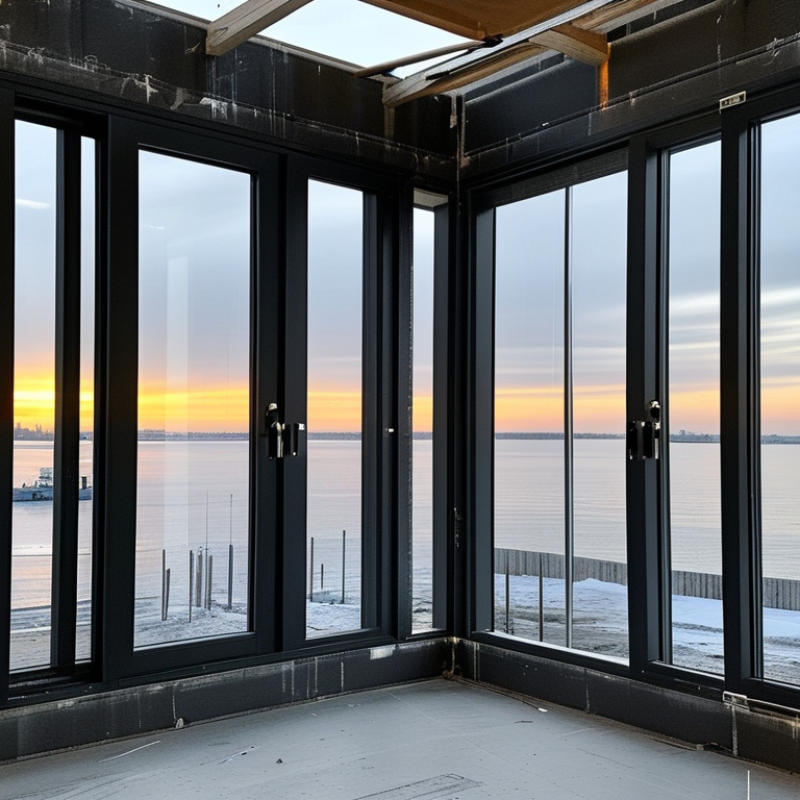
Set Performance Targets: U-Factor ≤0.30 and Low-E Solar Control
How to Choose Doors and Windows for Global Sourcing in 2026?
Set a U-factor target of 0.30 or lower for doors and windows. U-factor measures heat transfer through the whole assembly. Lower values generally improve insulation. The U.S. Department of Energy estimates that windows can cause 25–30% of residential heating and cooling energy use. That percentage makes specification work important, not decorative.
Low-E solar control glass needs a separate target. Select a lower Solar Heat Gain Coefficient, or SHGC, for hot climates with strong sunlight. In colder regions, moderate solar gain may support winter heating. The International Energy Agency reports that global space-cooling demand could more than triple by 2050 without efficiency improvements. Climate data should guide the glass choice. One number cannot fit every market.
Require NFRC-style certified ratings, including frame, glass, spacer, and operating hardware. Ask suppliers for test reports, sample labels, and air-leakage results. Check performance after repeated opening cycles. A beautiful sample can still fail at the gasket. I have seen specifications focus on glass while ignoring the frame. That is a costly blind spot. Also verify units, testing conditions, and local installation methods before comparing quotations. Ratings are useful, but installation errors can quietly defeat them.
How to Choose Doors and Windows for Global Sourcing in 2026? - Set Performance Targets: U-Factor ≤0.30 and Low-E Solar Control
| Performance Dimension | Recommended 2026 Target | Typical Reference Unit | Why It Matters for Global Sourcing | Verification Method |
|---|---|---|---|---|
| Whole-Product U-Factor | ≤ 0.30 | Btu/h·ft²·°F Approximately ≤ 1.70 W/m²·K |
Reduces heat transfer through the complete assembled window or door, including frame, sash, glazing, and spacers. | Require certified whole-product test results; do not rely only on center-of-glazing values. |
| Solar Heat Gain Coefficient (SHGC) | 0.25–0.40 for cooling-dominated exposure 0.35–0.55 for heating-dominated exposure |
Dimensionless, 0–1 | Controls solar heat entering the building. Lower values generally reduce cooling loads; higher values can provide useful passive solar heat in cold climates. | Check certified NFRC or equivalent laboratory data for the exact glass, frame, and product size. |
| Low-E Solar-Control Glazing | Double glazing with a low-emissivity coating; use solar-control Low-E where cooling demand is significant. | Typical emissivity of coated glass: approximately 0.04–0.15, depending on coating and test method | Combines reduced long-wave heat transfer with controlled solar transmission while preserving daylight. | Request coating position, glass make-up, emissivity data, visible transmittance, and spectrophotometric test records. |
| Visible Transmittance (VT) | 0.45–0.65 for a balanced daylight and solar-control solution | Dimensionless, 0–1 | Supports daylight access. Very low VT may increase artificial-lighting demand even when solar heat gain is well controlled. | Compare VT and SHGC together; avoid selecting glass on SHGC alone. |
| Air Leakage | ≤ 0.30 cfm/ft² at 1.57 psf for operable windows and doors | cfm/ft² at a specified pressure difference Approximately ≤ 1.5 L/s·m² at 75 Pa |
Limits drafts, uncontrolled energy loss, dust entry, and moisture movement through the assembled product. | Use laboratory air-infiltration testing on representative sizes and opening types. |
| Water Penetration Resistance | Select a tested pressure rating suitable for the project exposure; a practical starting point is ≥ 15 psf for many low- to mid-rise applications. | psf or Pa 15 psf ≈ 720 Pa |
Helps prevent rain penetration, especially on tall buildings, coastal sites, and windward elevations. | Specify a product test pressure based on local wind exposure, building height, and installation design. |
| Condensation Resistance | ≥ fifty on a 0–100 rating scale where available; prioritize thermally improved frames and warm-edge spacers. | Rating index, 0–100 | Reduces interior condensation risk in cold climates and during high indoor humidity conditions. | Request condensation-resistance ratings for the complete product, not glass-only calculations. |
| Acoustic Performance | STC 30–35 for ordinary urban housing; STC 35–40+ near major traffic or high-noise locations. | STC rating, dimensionless | Supports occupant comfort and may influence window selection in urban, hospitality, education, and healthcare projects. | Use laboratory whole-product ratings; laminated or asymmetric glazing may improve sound insulation. |
| Frame Thermal Design | Thermally broken aluminum, insulated vinyl, fiberglass, timber, or composite frames selected to achieve the whole-product U-factor target. | Whole-product U-factor and frame conductivity data | A high-performance glass unit cannot compensate for a highly conductive or poorly sealed frame. | Review thermal-bridge details, frame cross-sections, spacer type, and product-size calculations. |
| Door Threshold and Weather Seal | Continuous compression seals, adjustable or thermally improved threshold, and drainage paths; maintain the project U-factor target where applicable. | Air leakage, water resistance, and U-factor test results | Door bottoms and thresholds are common locations for air leakage and water entry. | Inspect corner joints, sill drainage, seal compression, and hardware adjustment during sample approval. |
| Glass Safety | Use safety glazing in hazardous locations and select laminated or tempered glass according to applicable local requirements. | Glass thickness, impact classification, and safety-glazing compliance | Protects occupants and reduces injury risk in doors, sidelites, low glazing, and impact-prone areas. | Confirm glass markings, safety documentation, and location-specific code compliance. |
| Solar Orientation Strategy | Use lower SHGC on high-solar exposures; evaluate external shading before reducing VT excessively. | SHGC, VT, orientation, shading coefficient | The best glazing differs by latitude, façade orientation, shading, internal gains, and heating or cooling balance. | Assess north, south, east, and west elevations separately using project energy calculations. |
| Documentation for Supplier Qualification | Require a product data sheet, certified test report, glass make-up, frame section, installation details, warranty terms, and quality-control records. | Document checklist | Makes quotations comparable and reduces the risk of performance changes between the approved sample and mass production. | Audit the production line, approve a sealed reference sample, and verify batch consistency before shipment. |
Related Posts
-

China Top 10 Doors and Windows Manufacturers
-

2026 Top Types of Doors and Windows for Global Buyers
-

How to Choose the Right Cooler Panels for Your Needs?
-

2026 Top Cladding Panels Trends Innovations and Applications?
-

Revolutionizing Construction: The Rise of Composite Cladding Panels in Modern Architecture
-
Future of Freezer Panels Industry Highlighted at the 138th China Import and Export Fair in 2025