What Are the Top Types of Composite Panels in 2026?
Composite panels are no longer a niche choice for construction, transport, interiors, or industrial equipment. In 2026, the leading options include aluminum composite panels, insulated metal panels, honeycomb panels, wood-based composites, and fiber-reinforced polymer panels. Each combines materials differently to balance weight, strength, insulation, appearance, or resistance to moisture. The right choice depends on the job.
This guide compares common panel types by their construction, practical advantages, limitations, and typical uses. Aluminum composite panels, for example, pair thin metal skins with a core, while insulated metal panels integrate insulation between metal facings. Honeycomb panels use a lightweight cellular core; wood-based products rely on bonded fibers or strands. Fiber-reinforced panels offer another option where corrosion resistance or easy cleaning matters. Performance varies by product and specification. The details matter.
There is no single “best” panel for every project. Buyers and specifiers should check technical data, including thickness, core material, load capacity, thermal performance, finish, and installation requirements. Fire performance and weather exposure also deserve careful review, since ratings and suitability can differ between products. Not every panel fits. Some comparisons are imperfect: product names can overlap, and manufacturer claims are not always directly comparable. The following overview explains the main categories and the factors that can help narrow a selection responsibly.
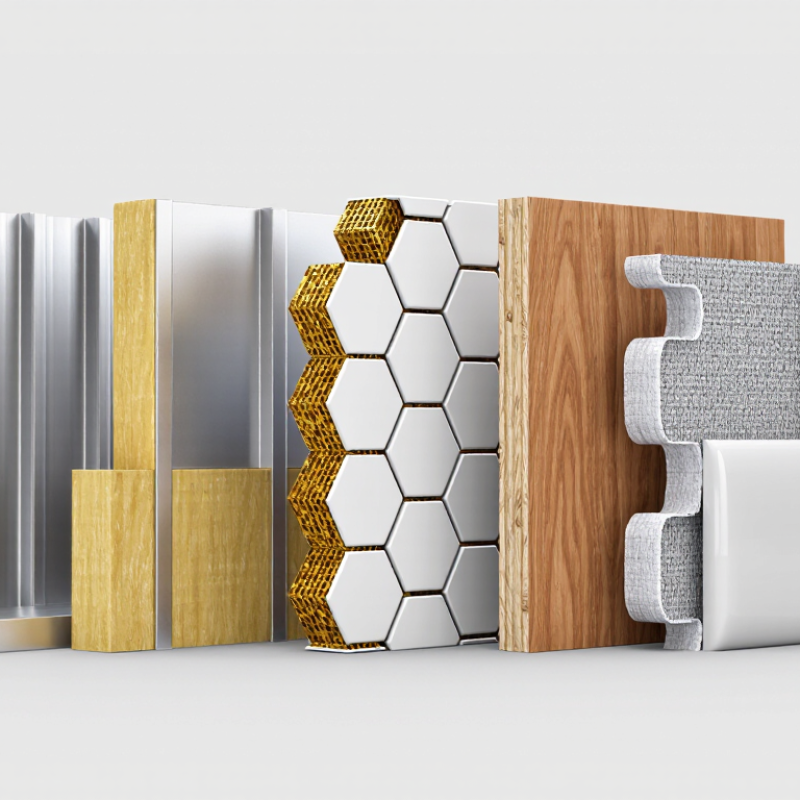
What Composite Panels Are and How They Are Classified
Composite panels join two or more materials to combine strength, low weight, insulation, or surface durability. Their behavior depends on the core, the outer layers, and how firmly those layers bond. A plywood sheet, a foam-core building panel, and a metal-faced panel are all composites, but they serve different jobs. The category is broad.
A useful first classification is by core: solid wood veneers, wood fibers or particles, foam, honeycomb, or mineral material. A second is by facing: timber veneer, paper, metal sheet, or fiber-reinforced skin. FAO’s Global Forest Products Facts and Figures 2022 reported about 401 million cubic metres of wood-based panel production worldwide in 2022. That figure covers major products such as plywood, particleboard, and fiberboard, not every engineered panel. The distinction matters.
Common types include plywood, MDF and HDF, particleboard, structural insulated panels, and metal-faced sandwich panels. Plywood uses cross-laid veneers; MDF uses fine fibers, creating a smooth surface for painting. Particleboard uses larger wood particles and often costs less, but moisture can cause trouble. Foam-core panels pair insulation with structural facings, while honeycomb cores reduce weight. In practice, labels can blur: a panel’s exact performance depends on its resin, thickness, joints, and exposure. Classification alone is not a specification.
What Are the Top Types of Composite Panels in 2026? – What Composite Panels Are and How They Are Classified
Composite panels combine two or more materials to achieve a useful combination of properties. The categories below are common panel types, not a market-share ranking; classifications can overlap because panels may be grouped by their faces, core, reinforcement, or manufacturing method.
| Panel type | How it is classified | Typical construction | Common characteristics | Typical applications |
|---|---|---|---|---|
| Aluminium composite material (ACM) panel | Metal-faced, layered panel | Two thin aluminium sheets bonded to a core, which may be polymer-based or mineral-filled. | Flat, lightweight, and easy to fabricate. Fire performance depends on the core, panel design, and applicable testing and building codes. | Building façades, soffits, signage, and interior wall finishes. |
| Insulated metal sandwich panel | Structural sandwich panel classified by its core | Metal facings bonded to an insulating core, such as polyisocyanurate (PIR), polyurethane (PUR), expanded polystyrene (EPS), or mineral wool. | Combines a finished surface with thermal insulation. Thermal, fire, and structural performance varies with the facing, core, thickness, and assembly. | Industrial buildings, cold stores, warehouses, and other insulated wall or roof assemblies. |
| Fiber-reinforced polymer (FRP) panel | Fiber-reinforced composite | Glass fibers or other reinforcing fibers embedded in a polymer resin matrix; some panels use a sandwich core. | Low weight and good resistance to corrosion in many environments. UV exposure, fire properties, and chemical resistance depend on the resin and panel specification. | Industrial wall linings, transport interiors, equipment enclosures, and areas exposed to moisture or corrosive conditions. |
| Plywood | Engineered wood panel classified by layered veneers | Thin wood veneers bonded in layers, usually with adjacent grain directions arranged at right angles. | Cross-laminated construction helps provide strength and dimensional stability. Grade, adhesive, veneer species, and exposure rating affect suitability. | Construction sheathing, flooring, roofing, furniture, and concrete formwork grades. |
| Oriented strand board (OSB) | Engineered wood panel classified by oriented wood strands | Wood strands arranged in layers and bonded with adhesive under heat and pressure; strand orientation differs between layers. | Structural properties depend on the product grade and intended service conditions. Edge swelling can occur if the panel is exposed to moisture. | Wall, roof, and floor sheathing; subfloors; and other specified structural uses. |
| Medium-density fibreboard (MDF) | Engineered wood panel classified by refined wood fibers | Wood fibers combined with resin and pressed into a dense, uniform panel. | Smooth faces suit painting and decorative finishes, and the material can be machined cleanly. Standard grades are intended for dry conditions unless otherwise specified. | Cabinet components, furniture, mouldings, shelving, and interior joinery. |
| Cement-bonded particleboard | Mineral-bonded wood composite | Wood particles or chips bonded with cement and pressed into a panel. | Generally more resistant to moisture, decay, and fire than untreated wood-based boards, but it is heavier and must be installed according to its product specification. | Exterior sheathing, partitions, flooring systems, and other construction uses where the specified grade is suitable. |
| Compact high-pressure laminate (HPL) | Resin-impregnated layered laminate | Decorative and kraft papers impregnated with thermosetting resins, consolidated under heat and pressure; compact grades are self-supporting. | Durable decorative surface with good resistance to everyday wear. Edge details, fixing method, and exterior suitability depend on the grade and application. | Wall cladding, toilet cubicles, laboratory furniture, worktops, and high-use interior surfaces. |
Related Posts
-
2026 How to Choose the Right Composite Cladding for Your Home?
-
Top Types of Wall Cladding Panels for Modern Architecture?
-

Top Wall Composite Cladding Trends at Canton Fair 2026?
-
How to Choose the Best Wall Cladding Panels for Your Project?
-
2026 Best Composite Cladding Options for Global Buyers?
-
2026 Best Wall Cladding Composite for Global Buyers?